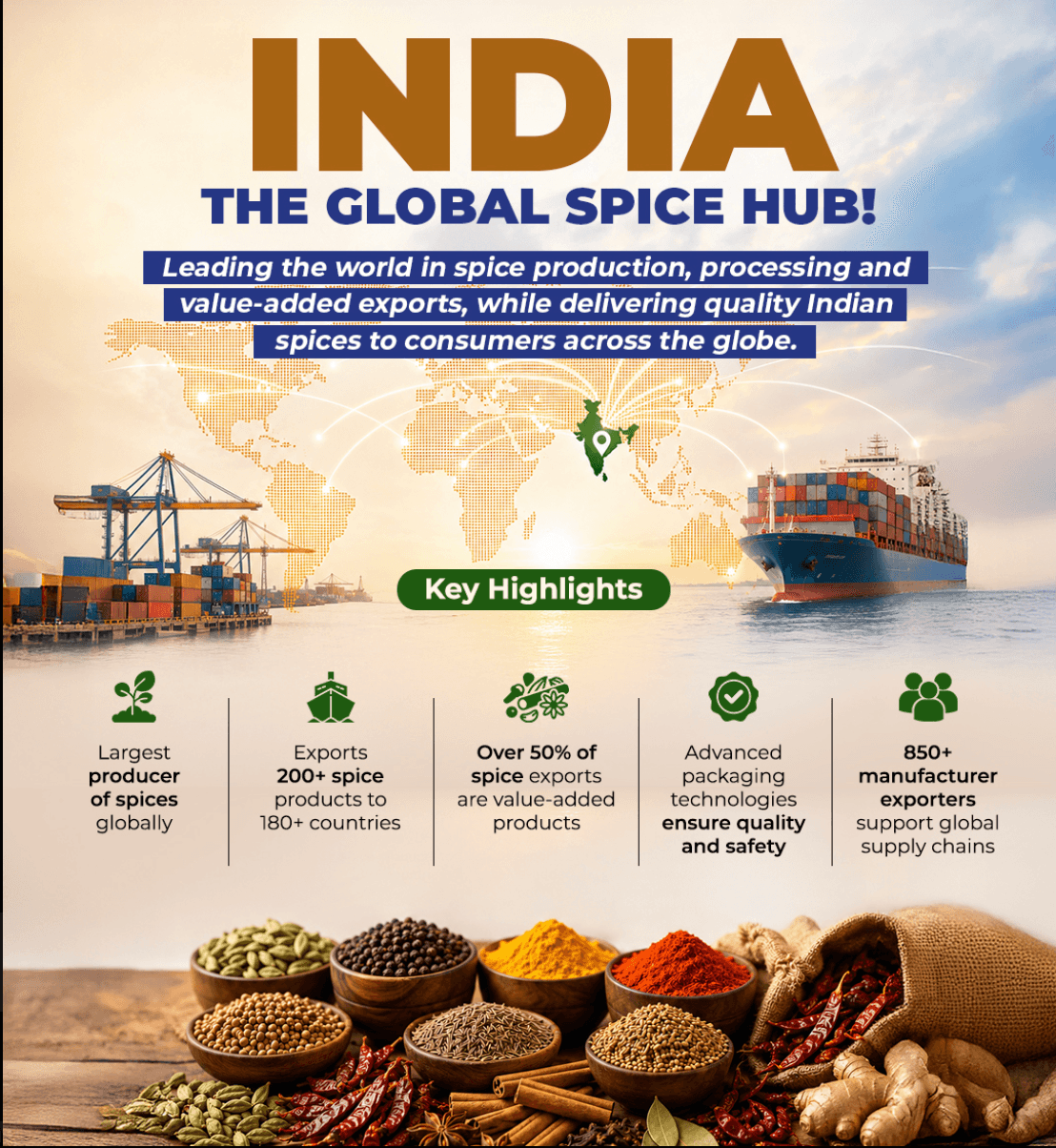
Syria's cumin collapsed 86%. Iran faces sanctions. Turkey hit by drought. Vietnam pepper at decade highs. Geopolitics has permanently shifted global spice supply toward India. Here's what importers need to know.
How Geopolitics Is Permanently Redrawing the Global Spice Supply Map
The global spice supply map that existed in 2015 no longer exists. It has been redrawn - not by market forces alone, but by a decade of compounding geopolitical disruptions that have permanently removed or severely degraded several of the origins that once competed meaningfully with India across key spice categories. The result is a supply landscape where India's dominance, already structural, has deepened further - and where importers who have not yet adjusted their sourcing strategy to reflect this new geography are carrying concentration risk in the wrong direction.
The geopolitical spice supply disruption story runs across multiple origins and multiple categories simultaneously. Syrian cumin - once a meaningful global supply source - has collapsed by 86% from its 2010 output levels. Iranian spice exports face banking complications and export restrictions from sanctions. Turkish cumin and coriander production has been hit by repeated drought and crop failures. Vietnam's black pepper supply has been structurally reduced by a decade of farmer replanting decisions following the 2018 price crash. Guatemala's cardamom crop suffered severe damage from climate events. And the 2026 Iran-US conflict has now added the Strait of Hormuz disruption and Gulf supply chain paralysis to an already strained global spice logistics environment.
India did not engineer this consolidation. It simply maintained production capacity, export infrastructure, and regulatory compliance while competing origins contracted. The result is that India now controls approximately 87% of global cumin supply, around 80% of global turmeric supply, and is the dominant or co-dominant supplier for chili, coriander, cardamom, fenugreek, and several other categories. For global importers, this is the single most important supply chain fact in the spice trade right now.
Origin by Origin | The Competitive Collapse
Syria and the Cumin Vacuum
Syria was historically one of the world's significant cumin producers. The country's production has collapsed from approximately 35,000 metric tonnes in 2010 to under 5,000 metric tonnes in 2024 - an 86% decline driven by over a decade of civil conflict, infrastructure destruction, and agricultural disruption. Syrian cumin was competitive on price and had established buyer relationships, particularly in Europe and the Middle East. Those supply relationships no longer have a functional origin to connect to.
The buyers who previously sourced Syrian cumin have overwhelmingly redirected to India. This demand transfer is not cyclical - Syrian agricultural infrastructure cannot be rebuilt quickly, and the political situation remains unstable. For importers, the Syrian cumin supply is gone for the foreseeable future.
Iran | Sanctions, Banking, and Export Friction
Iran produces cumin, saffron, and several other spices that historically found their way into global trade through intermediary markets - particularly the UAE and Turkey. Iranian sanctions have created banking complications that make direct import-export transactions extremely difficult for most international buyers. Export restrictions and payment pathway limitations have reduced reliable Iranian supply significantly.
The 2026 Iran-US conflict has compounded this further. Iranian spice exports, already constrained by sanctions, now face the additional logistics disruption of a regional military conflict that has shut Gulf shipping lanes, removed Jebel Ali as a transshipment hub, and created insurance and banking complications that extend far beyond the spice trade. Iran spice export disruption is now both structural (sanctions) and acute (active conflict). Importers who were accessing Iranian supply through intermediaries should assess whether those channels are still operationally functional.
Turkey | Drought, Crop Failure, and Declining Competitiveness
Turkey is a significant producer of cumin, coriander, and other seed spices, with its production zones concentrated in Central and Eastern Anatolia. Repeated drought and crop failures in 2022 to 2024 seasons have reduced Turkish output and raised production costs. Turkish cumin now commands pricing that is 20 to 30% higher than equivalent Indian cumin - without the quality advantages that would justify that premium. Buyers comparing Indian Unjha-grade cumin at $3.40 to $3.80 per kilogram FOB against Turkish cumin at comparable or higher prices are increasingly choosing India on value grounds, not just availability.
Vietnam | Structural Pepper Deficit
Vietnam accounts for over 40% of global black pepper exports but has been operating at a structural supply deficit since 2019. Vietnamese farmers uprooted pepper vines en masse in 2018 when prices crashed, shifting to more profitable crops. Pepper vines take three to four years to reach productive maturity. The replanting deficit from 2018 decisions is still reducing 2025 and 2026 harvests, with Vietnamese output approximately 47% below its 2018-2019 peak. Prices reached decade highs as a result - Vietnam's benchmark 500g/L grade averaged $6,607 per tonne across 2025, a 36.2% increase year-on-year.
This is not a weather event that will resolve in one growing season. The replanting decisions of 2018 will constrain Vietnamese pepper supply through at least late 2026 and into 2027. For pepper buyers, India - which produces premium-grade Malabar pepper in Kerala and Karnataka - has become the quality-anchored alternative origin for buyers who need reliability and specification consistency.
Guatemala | Cardamom Under Pressure
Guatemala produces approximately 70% of the world's cardamom exports. A severe crop damage event in 2025 - triggered by weather disruption across the Alta Verapaz and Huehuetenango growing regions - disrupted traditional supply flows and redirected demand toward Indian cardamom. India is the world's second-largest cardamom producer, and its export volumes rose 37.6% year-on-year in April-July 2025 as buyers sought alternatives to Guatemalan supply.
The Guatemala cardamom situation illustrates a broader pattern: when a concentrated-origin commodity faces disruption, there is only one alternative at scale. For cardamom, that alternative is India.
The 2026 Iran-US Conflict | A New Layer on an Existing Shift
The conflict that began February 28, 2026 has added an acute disruption layer on top of the structural supply shifts already underway. The Hormuz spice supply chain impact is real and specific.
Spices grown in or transiting through Gulf countries face direct logistical disruption. Jebel Ali - the UAE's massive transshipment hub and the primary distribution center for spices moving between India and the Middle East and Africa - temporarily suspended operations after drone strikes in early March. Insurance withdrawal for Gulf vessel transits created a logistics vacuum that even willing carriers cannot easily fill.
For importers whose supply chains routed through Jebel Ali - either for direct Gulf market supply or for transshipment to African destinations - the current disruption has created delivery timeline uncertainty and cost increases that require immediate supply chain review.
India's position relative to this disruption is distinctive. India received an explicit Strait transit exemption from Iran in late March 2026. Indian-flagged vessels have more routing flexibility than European-flagged carriers on the origin-country side. Indian ports - Nhava Sheva and Mundra - are fully operational and unaffected by the conflict. And India's Cape of Good Hope routing to European and other markets was already normalized during the 2023-2024 Red Sea crisis, meaning Indian exporters and their freight partners have the operational experience with alternative routing that newer entrants to the Cape route lack.
What the Supply Map Shift Means Practically
The India spice supply dominance that has resulted from this geopolitical consolidation creates specific strategic implications for importers that go beyond simply noting that India is the largest source.
Single-origin concentration risk has shifted. A decade ago, an importer who sourced cumin from Syria and India, or pepper from Vietnam and India, had genuine multi-origin diversification. Today, Syria is effectively unavailable, Turkey is uncompetitive on price, Iran is restricted and disrupted, and Vietnam is supply-constrained. Real diversification in cumin means different Indian growing regions and different Indian exporters - not different countries. Understanding this correctly is essential for procurement risk assessment.
India's pricing power has increased. When competing origins contract, the remaining dominant supplier's pricing power increases. This is already visible in Indian pepper pricing ($8.10 to $8.40/kg at the India premium) and in Indian cumin's price stability despite domestic supply fluctuations, because the alternatives are structurally unavailable or uncompetitive. Importers who plan procurement around continued competitive pressure on Indian prices from alternative origins are working with an outdated model.
Supplier quality differentiation matters more than ever. When India is effectively the only source for several key categories, the quality difference between India's best and worst suppliers becomes the quality difference between acceptable and unacceptable supply. An importer who accepted a lower-quality Indian supplier when they had Syrian or Turkish alternatives as backstops no longer has that backstop. Supplier qualification rigor needs to match the new supply geography.
The India-UK CETA and India-EU FTA improve the economics of the shift. The geopolitical consolidation toward Indian origins is now being complemented by trade agreement improvements. The India-UK CETA entering into force in May 2026 eliminates tariffs on virtually all Indian food exports to the UK. The India-EU FTA signed in January 2026 is progressively reducing tariffs for European buyers. The combination of structural supply necessity and improving trade economics makes India's position in global spice supply more dominant than at any point in modern trade history.
Building a Resilient India~Anchored Supply Chain
For importers who recognise that Indian spice market dominance is now the central fact of the global spice supply landscape, the practical procurement question is how to build a supply chain that captures the advantages of India's position while managing the risks that come with any concentrated-origin dependency.
The answer is not to find alternatives to India - the alternatives have largely contracted. The answer is to build depth within India. Qualify multiple Indian suppliers across different growing regions for your key categories. Cumin: Unjha and Jodhpur. Turmeric: Erode, Nizamabad, and Alleppey. Pepper: Kerala Malabar coast certified exporters. Cardamom: Kerala and Karnataka. Maintain supplier relationships with at least two qualified exporters per category, with documented quality agreements and tested logistics arrangements. This gives you the multi-source resilience that multi-origin sourcing used to provide.
At Bayharbor Exports, we supply the complete range of Indian spices for global importers - turmeric, cumin, coriander, black pepper, cardamom, chili, and fenugreek - with full FSSAI certification, third-party laboratory testing, and logistics arrangements adapted to current routing realities. Our operations are unaffected by the Gulf conflict.