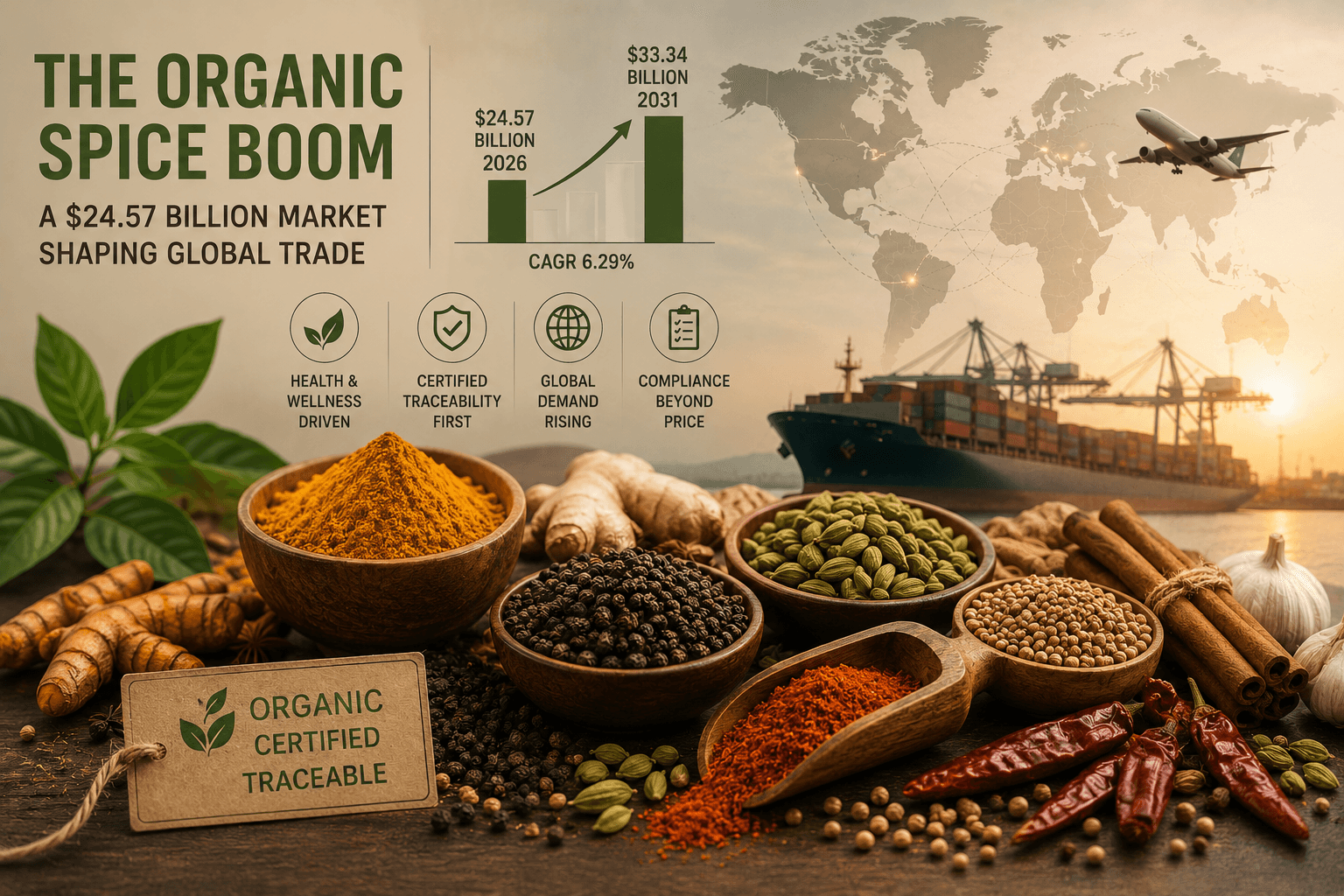
The organic spice market has reached $24.57 billion and is projected to hit $33.34 billion by 2031. For global importers, the defining shift is not the scale — it is that certified traceability now outweighs price as a market entry requirement. This breakdown covers what the USDA SOE rule, EU organic regulations, and India's NPOP infrastructure mean for your 2026 sourcing strategy.
A report published by Mordor Intelligence on May 7, 2026 confirmed what procurement teams in European and North American markets have been observing for the past two years: the organic spice market is no longer a niche category. It is a $24.57 billion global market growing at a CAGR of 6.29%, projected to reach $33.34 billion by 2031. The report's most consequential finding for importers was not the growth number itself but what is driving it: certified traceability has become more vital for market entry than price alone.
That single sentence restructures the competitive dynamics of the entire spice import market. The buyers who win organic spice category shelf space, foodservice contracts, and nutraceutical supply agreements in 2026 are not the ones with the lowest landed cost. They are the ones whose supply chains can demonstrate, document, and digitally verify origin-to-delivery traceability - and whose Indian suppliers hold the certifications that regulated import markets actually require.
This blog breaks down the organic spice boom, what is driving it, what it demands from importers and their suppliers, and how India's certification infrastructure positions it as the natural primary source for the global organic spice supply chain.
The Market Structure | Where the Demand Is Coming From
The organic spice demand drivers in 2026 are operating simultaneously across four distinct consumer segments, which is what makes the growth unusually durable.
Health and wellness consumers are the original and still the largest segment. The pandemic permanently elevated consumer attention to immune support, anti-inflammatory nutrition, and clean-label food products. Chemical-free, residue-free spices that carry organic certification are the direct beneficiary of this structural shift in consumer priorities. Organic turmeric, organic ginger, and organic black pepper are among the fastest-growing SKUs in health food retail globally.
Food manufacturers and processors are the high-volume engine of organic spice growth. Mainstream food manufacturers are reformulating product ranges with organic-certified spice inputs to meet retailer clean-label requirements and to access the premium retail shelf space that organic positioning unlocks. The global blended spices market - where processed food manufacturers are the primary buyers - is projected to grow from $8.62 billion in 2025 to $9.28 billion in 2026, with the B2B segment growing at 8% CAGR, faster than the overall market.
Nutraceutical and pharmaceutical buyers represent the segment with the most rigorous specification requirements. Standardized curcumin extracts, piperine-enhanced bioavailability formulations, and ginger oleoresins for pharmaceutical applications all require organic-certified raw material with lot-level traceability documentation. US curcumin supplement sales reached $151.7 million, and the buyers in this segment are specifying not just organic certification but specific curcumin percentages, heavy metals testing, and pesticide residue verification to parts-per-billion level.
Retail and e-commerce buyers across Europe, North America, and increasingly East Asia are expanding organic spice shelf space rapidly. In the UK, the organic spice industry is supported by a robust health food retail sector with strong consumer awareness of food provenance - brands have introduced QR-coded sourcing information and sustainable packaging. Under the European Green Deal and Farm to Fork Strategy, EU countries are actively expanding organic product ranges. Organic spice blends have the highest retail sales in Germany, France, and the Netherlands.
The Compliance Revolution | Why Traceability Now Beats Price
The most significant structural shift in the organic spice supply chain is not demand-side - it is compliance-side. Two regulatory developments have fundamentally raised the entry bar for organic spice suppliers.
The USDA Strengthening Organic Enforcement (SOE) Rule, which took effect March 2024, mandated NOP Import Certificates for all imported organic products and broadened certification requirements to encompass brokers and traders. The rule was introduced in direct response to investigations that uncovered significant fraudulent organic imports. Its practical effect for importers: every link in the supply chain from Indian farmer to US buyer must now be certified, documented, and verifiable. Claiming organic without the documentation infrastructure to prove it - at every stage - is now a legal liability, not just a reputational one.
The Frontier Co-op example illustrates what serious US organic buyers now require from Indian suppliers: USDA NOP equivalence through Indian NPOP certification from bodies like Ecocert or OneCert Asia, steam sterilization records, farm-level documentation proving no synthetic pesticides for 36 months, pesticide residue testing below 0.01ppm across 400+ compounds, and heavy metals verification. This is not premium specification - it is the baseline for accessing the Whole Foods, Thrive Market, and natural food distribution channels.
EU Organic Regulations tightened in January 2025. Combined with the SOE rule, this creates what Mordor Intelligence calls a "dual-compliance challenge" for global suppliers - simultaneously meeting US NOP and EU organic requirements while maintaining the documentation infrastructure to prove compliance at both. For importers serving both markets, this means supplier qualification is now a strategic investment, not an administrative function.
The compliance environment is actively selecting for vertically integrated, well-capitalized Indian suppliers - and selecting against traders who aggregate from multiple unverified smallholder farms without the traceability infrastructure to link each lot to its certified origin. Smaller, undocumented suppliers face a genuine market access problem in 2026. Importers who source from them face a certification integrity risk.
India's Position | The NPOP Advantage
India's NPOP organic certification framework is the structural foundation of the India-to-world organic spice supply chain. The National Programme for Organic Production is mutually recognized by the European Union, the US (through equivalency arrangements for NOP), Switzerland, and several other major import markets. This mutual recognition is commercially significant: it means NPOP-certified Indian spice exporters can access EU organic retail channels without a separate EU certification process - provided the certification body is EU-recognized and the specific product category is covered.
By 2025, India had over 6,300 organic spice-producing farms certified by organic certification bodies globally, including USDA Organic, EU Organic, and India Organic. The scale of India's certified organic farming infrastructure - combined with APEDA's export oversight and the Farmer Producer Organization model that aggregates smallholder certified farms into commercially viable supply units - gives India a depth of organic supply that competing origins cannot match for most major spice categories.
Organic Indian spice exports are growing at a rate that significantly outpaces conventional spice exports. Organic turmeric from Erode and Lakadong commands up to 45% premium over conventional equivalents. Organic cumin from Gujarat's certified farms is sought by US buyers - with organic cumin exports to the US up 15 to 20% year on year. Organic black pepper from Kerala's Malabar coast commands $4.50 to $6.00 per kilogram FOB compared to $3.50 to $4.00 for conventional - a 35 to 45% margin premium for compliant suppliers.
The blockchain traceability layer is now being added on top of certification infrastructure. Companies like Rapid Origins are deploying blockchain and AI-powered quality control for farm-to-port traceability, enabling QR-code verified provenance that retail buyers and e-commerce platforms increasingly demand from premium organic products. This technology is being adopted faster in India's export-oriented organic spice sector than in most competing origins, because India's exporter community understands that documentation quality is now a commercial differentiator.
The Categories Driving the Most Growth
Within the broad organic spices market growth, certain categories are growing materially faster than others and deserve specific attention from importers building organic supply chain positions.
Organic turmeric is the standout. Global interest in curcumin's anti-inflammatory and antioxidant properties, combined with the explosive growth of functional foods and nutraceuticals, has made organic turmeric with verified curcumin content the single most sought-after organic spice category in both US and European markets. Untimely rains in 2024-2025 reduced curcumin content in some Indian growing regions, creating a quality differentiation opportunity for importers who specify curcumin percentage and source from certified high-curcumin varieties like Lakadong.
Organic ginger is growing through multiple channels simultaneously - vegan baking, gourmet sauces, functional beverages, and pharmaceutical anti-nausea formulations. Traceable fair-trade ginger supply chains are an emerging premium positioning for brands targeting values-conscious consumers.
Organic black pepper is benefiting from the convergence of the piperine-bioavailability story (piperine in black pepper increases curcumin absorption by up to 2000%, making black pepper a co-ingredient in virtually every turmeric supplement formulation) with the general organic wellness trend. Every organic turmeric supplement on the market also needs organic black pepper - the two are supply chain companions.
Organic cardamom faces a supply challenge from Guatemala's crop disruption and is one of the most supply-constrained organic spice categories globally. Indian organic cardamom from Kerala and Karnataka is increasingly sought by buyers who cannot source from Guatemala at certified organic quality.
What Importers Need to Do to Capture the Organic Premium
The organic spice sourcing strategy for importers targeting premium markets in 2026 comes down to four disciplines.
Supplier certification verification. Don't assume certification - verify it. NPOP certificates expire and must be renewed. Certification bodies vary in their EU and US recognition status. Confirm current validity, coverage of your specific product category, and the certification body's recognition status in your destination market before committing to a supply relationship.
Lot-level documentation. The SOE rule and EU organic regulations both require lot-level traceability. Each shipment must be traceable to its certified farm or farm group. This requires Indian suppliers with farm-level records, not just processing facility certification.
Pre-shipment testing. Organic certification is a process standard, not a quality guarantee. Pesticide residue testing and heavy metals verification from an accredited laboratory should accompany every shipment. The Frontier Co-op specification of 400+ compound pesticide residue testing below 0.01ppm sets the benchmark for serious organic buyers.
Premium pricing negotiation. Organic Indian spices command 25 to 45% premiums over conventional in most categories. These premiums are real and stable because the compliance and certification costs are real. Attempting to compress the organic premium to near-conventional pricing undercuts the supply chain quality infrastructure that makes the certification credible.
At Bayharbor Exports, we supply certified organic Indian spices - turmeric, cumin, coriander, black pepper, cardamom, ginger, and fenugreek - with NPOP certification, third-party laboratory certificates of analysis covering curcumin content, pesticide residues, and heavy metals, and full lot-level traceability documentation compatible with US NOP and EU organic requirements. Our guide for European importers on the India-EU FTA covers the improving tariff landscape for EU buyers of Indian organic spices.