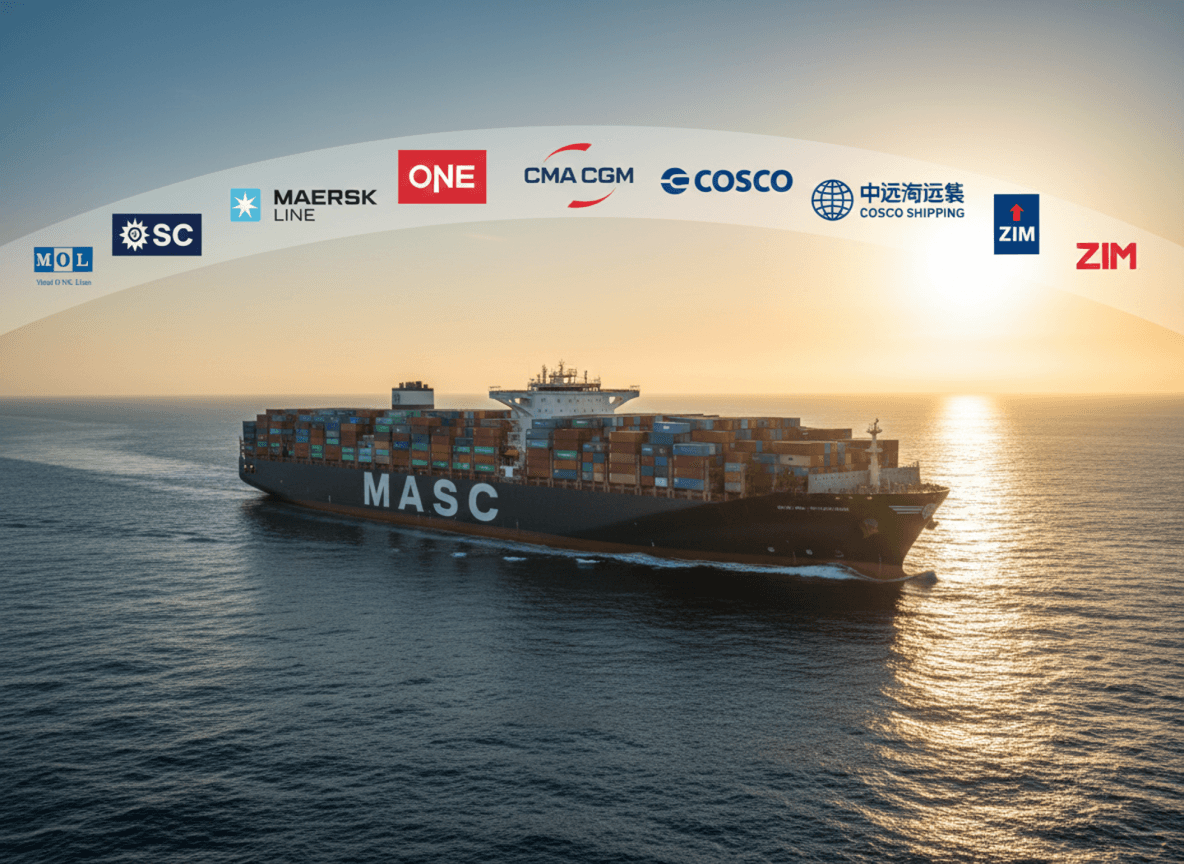
MSC, Maersk, CMA CGM, Hapag-Lloyd each shipping line has strengths on different India routes. Here's how to pick the right one for your cargo and destination.
Which Shipping Line Should You Use When Importing from India?
Nobody talks about shipping lines until something goes wrong. A vessel misses its schedule. A container gets rolled to the next sailing. Your basmati rice was supposed to arrive in Rotterdam three weeks ago and it's still sitting in Nhava Sheva (JNPT). At that point, the question of which carrier you should have booked becomes very relevant, very fast.
Choosing a shipping line isn't just an operational checkbox. It's a decision that affects your ocean freight rates, your delivery windows, your documentation experience, and ultimately how reliably you can serve your own customers. And in 2025, with alliance shake-ups reshaping India export shipping routes, Red Sea diversions adding transit time, and freight rates swinging unpredictably, picking the right carrier matters more than it used to.
This guide breaks it down for importers and exporters working India-origin FCL shipments who the major players are, what they're actually good at, and how to think about the choice for your specific situation. If you're still evaluating whether to source from India at all, our guide on how American importers can benefit from the US-India trade deal is a good place to start first.
The Landscape Right Now
The global container shipping industry is dominated by a handful of carriers. As of 2025, MSC leads with roughly 20.8% of global capacity, followed by CMA CGM (which recently surpassed Maersk for the second spot), Maersk, COSCO, and Hapag-Lloyd. Together, the top five control nearly 65% of global container capacity. Below them sit ONE (Ocean Network Express), Evergreen, HMM, Yang Ming, and ZIM all meaningful players with specific route strengths.
What's changed significantly in 2025 is how these carriers are organized. The old alliance structures have been reshuffled. Maersk and Hapag-Lloyd now operate together under the Gemini Cooperation, built around a hub-and-spoke model designed to maximize schedule reliability and the shipping line schedule reliability data for 2025 reflects that. Independent analysis puts Gemini's on-time performance on key East-West corridors close to 90%, while the industry average sits in the mid-60% range. CMA CGM, COSCO, OOCL, and Evergreen operate together under the Ocean Alliance. ONE, HMM, and Yang Ming form the Premier Alliance. And MSC, after parting ways with Maersk in early 2025, now operates independently relying on sheer fleet scale to compete on coverage and price.
Understanding which alliance a carrier belongs to matters because it affects which vessels your cargo rides on, which ports get priority calls, and how your booking options shift when capacity tightens.
The Main Carriers on India Routes And What They're Actually Good At
MSC is the biggest and arguably the most aggressive on price. It operates extensive India coverage through major ports Nhava Sheva (JNPT), Mundra, and Pipavav on the west coast, and Chennai and Kolkata on the east. For importers moving large FCL volumes who can absorb some schedule variability, MSC often comes in competitively on ocean freight rates. The tradeoff is that going independent has meant MSC relies more heavily on transshipment hubs rather than direct port calls, which can add transit time on certain lanes. For India to Middle East shipping and Africa routes, MSC's coverage is particularly strong; their Gulf-India frequency is among the best in the market.
Maersk is the choice when documentation and digital experience matter as much as the vessel itself. Their integrated logistics push door-to-door solutions, real-time tracking, digital customs documentation makes life easier for procurement teams who want visibility into exactly where their container is at any given moment. Within the Gemini alliance with Hapag-Lloyd, Maersk's schedule reliability on Europe and North America lanes has genuinely improved. If you're moving time-sensitive goods, spices tied to a customer contract, or basmati rice ahead of a festival season Maersk's reliability track record is worth paying a small premium for.
CMA CGM has been the most aggressive acquirer in the industry over the past few years, which has translated into strong coverage across both established and emerging lanes. Their India-to-Europe service is well-established, and their growing LNG dual-fuel fleet has made them the preferred carrier for importers who carry sustainability reporting requirements a growing consideration for European buyers. CMA CGM also has meaningful reach into the US Gulf Coast, which some carriers overlook. Their investment in logistics infrastructure (terminals, warehouses, freight forwarding networks) means they can offer something close to a fully managed service in certain markets.
Hapag-Lloyd, operating within Gemini alongside Maersk, shares the reliability advantage of that alliance. German-managed and process-driven, Hapag-Lloyd is a particularly strong choice for European importers and their coverage of Northern European ports is extensive, and their handling of food-grade containers and temperature-controlled shipments is consistently well-reviewed. For spices and pulses moving to Germany, Netherlands, or the UK, Hapag-Lloyd belongs on your shortlist.
COSCO is the dominant Chinese state-backed carrier, and its scale on Asia-Europe and trans-Pacific routes is formidable. For importers in East Asia or those moving Indian goods through Singapore or Hong Kong as transshipment points, COSCO's network is efficient and competitive on price. That said, some buyers in the US and Europe have become more selective about Chinese state-owned carriers given the evolving geopolitical environment, a consideration worth factoring into your procurement policy.
ONE (Ocean Network Express) was formed from the merger of three Japanese lines (NYK, MOL, K Line), and it has quietly built strong India-to-North America service. For US and Canadian importers, the transit time from India to USA via ONE's trans-Pacific routes is competitive, and their customer service reputation has improved substantially since their rocky early years. They don't always make the shortlist simply because they're less well-known which is exactly why they're often worth quoting.
Evergreen, the Taiwanese carrier best known for briefly closing the Suez Canal in 2021 has solid India route coverage and is a common choice for Southeast Asia-connected supply chains. They operate reliably on India-to-Southeast Asia lanes and connect well into broader Asia-Pacific networks.
ZIM, the Israeli carrier, is smaller but nimble. Digitally accessible, technology-forward, and strong on niche lanes. ZIM has built specific strength on the India-to-US East Coast lane and is often worth including in a rate comparison for that corridor.
How to Actually Make the Decision
The mistake most importers make is treating shipping line selection as a purely rate-based decision. Rate matters, nobody is suggesting you ignore it but it's one input among several, and it's often not the most important one.
Route and port pairing. Your first filter is which carriers actually serve your origin port and destination port with acceptable transit time from India. Shipping from Mundra to Felixstowe looks very different from Chennai to Houston in terms of which carriers are genuinely competitive. Ask your freight forwarder India for a comparison of actual sailing schedules not just brochure promises, but which vessel strings they are actively booking on.
FCL vs LCL If you're moving full container loads (FCL), your options are wider and your leverage on rate is better. For LCL (less than container load) shipments, you're relying on the freight forwarder to consolidate, so the carrier choice becomes partially abstracted. Most serious importers working at distribution scale should be aiming for FCL from the start the per-unit economics are significantly better.
Schedule reliability vs Price There is now a measurable, documented gap between carriers on this metric. If you're sourcing products with a fixed delivery window, seasonal demand, retail planograms, food service contracts pay for reliability. If you're shipping ambient staples with comfortable inventory buffers, you can optimize harder on ocean freight rates.
Indian food import compliance and documentation For food shipments specifically basmati rice, spices, lentils you're coordinating phytosanitary certificates, FSSAI documentation, Halal certificates, and destination-country import compliance requirements. Carriers with strong local teams at JNPT, Mundra, and Chennai make bill of lading issuance and customs coordination smoother. This is worth asking your freight forwarder about explicitly.
Container availability Some carriers struggle with equipment availability at certain Indian inland container depots (ICDs). If your cargo originates from an inland location rather than a major port city, confirm your chosen carrier has consistent containers available there before you commit.
Surcharges and total cost Base freight is not your landed cost. Peak Season Surcharges, Emergency Bunker Surcharges, Port Congestion Surcharges these stack differently across carriers. Always ask for an all-in rate when comparing.
Alliances, Red Sea, and What They Mean Practically
The Gemini, Ocean, and Premier alliance structures affect which vessels your cargo rides on and how your schedule holds up when capacity gets tight. Within an alliance, carriers share vessel space your Maersk booking might ride on a Hapag-Lloyd vessel, and vice versa. That's normal. What it means practically is that when evaluating a "direct service," confirm whether it's an alliance vessel or a chartered one, and what the transit time looks like on that specific string.
For Indian origin shipments, the Red Sea diversion situation remains active. Since late 2023, most carriers have been routing around the Cape of Good Hope rather than through Suez. This adds 7 to 14 days to transit time from India to Europe depending on the lane and carrier. The India-to-Europe transit time impact is something every procurement team planning to source from India needs to build into their lead time calculations. Ask each carrier explicitly how they're handling this on your routs.
How This Connects to Your India Sourcing Strategy
Your shipping line choice doesn't exist in isolation; it connects directly to what you're buying, where you're buying it from, and the trade conditions you're operating under.
If you're sourcing from India because of disruption in another supply chain, the US-Canada trade war pushing up costs on North American goods, for instance, or the US-China tariff situation making Chinese supply chains expensive then logistics reliability matters even more. You're already managing one disruption. You don't want to add a second one through a bad carrier choice. Our blog on how the US-Canada food trade war is reshaping importer supply chains covers the sourcing context in detail if that's relevant to your situation.
Similarly, if you're a European importer benefiting from the India-EU FTA signed in January 2026, reduced tariffs on Indian goods mean your landed cost calculation has shifted and it's worth revisiting your freight strategy to make sure you're capturing the full savings. Our complete guide for European importers on the India-EU FTA walks through the tariff changes and what they mean in practice.
At Bayharbor Exports, we work with experienced freight forwarders across our key lanes US, Canada, Europe, and the Middle East. We handle export documentation, phytosanitary certification, quality testing, and loading supervision on the India side so your container leaves correctly. We're also happy to share what we're seeing on the ground in terms of which carriers are performing well on your specific route.
The Bottom Line
There is no universally "best" shipping line for importing from India the right choice depends on your destination, volume, delivery windows, and risk tolerance. What's consistent is that this decision deserves more thought than a quick rate comparison.
In 2025, the carriers performing best on India export shipping routes are those that invested in reliability systems, maintained container availability at key Indian ports, and kept documentation processes functional through a period of significant industry change. Maersk and Hapag-Lloyd under Gemini for Europe and North America reliability. CMA CGM for sustainability-sensitive European lanes. ONE and ZIM for the US East Coast. MSC for India to Middle East shipping and price-sensitive high-volume movements.
Get all-in rate quotes. Compare actual sailing schedules, not headline transit times. Work with a freight forwarder India who knows the lanes. And if you're building your India sourcing strategy from the ground up, reach out to Bayharbor Exports we're happy to share what's working on the ground.