Over $165 billion in trade has shifted away from China in 2026, and India is the biggest winner. Here is what importers need to know about sourcing from India right now.
India Is Winning the Global Trade Realignment | Here Is What Importers Need to Know
Over $165 billion in trade has moved away from China in 2026. India is the biggest beneficiary. Here is what food importers need to know about the shift happening right now.
Something significant has shifted in global trade over the past 18 months, and it is accelerating in April 2026. The combination of US tariffs, the Supreme Court IEEPA ruling, the Middle East conflict, and three years of supply chain disruptions has done what no single event could achieve on its own: it has fundamentally restructured where importers buy from.
Over $165 billion in trade has moved to alternative countries as US-China trade has been cut significantly. US imports from Thailand are up 33%, Indonesia up 34%, Vietnam up 15% year-on-year. And sitting above all of them, with a GDP growth projection of 6.2% in 2026 and agricultural exports that crossed $50 billion in FY2024-25, is India.
The global supply chain realignment is not a forecast anymore. It is happening in real time. And for food importers specifically, India's position within this realignment is more compelling than it has been at any point in modern trade history.
Why This Moment Is Different for India
India has been talked about as a China alternative for years. What makes 2026 different is that the structural conditions are now in place simultaneously in a way they never have been before.
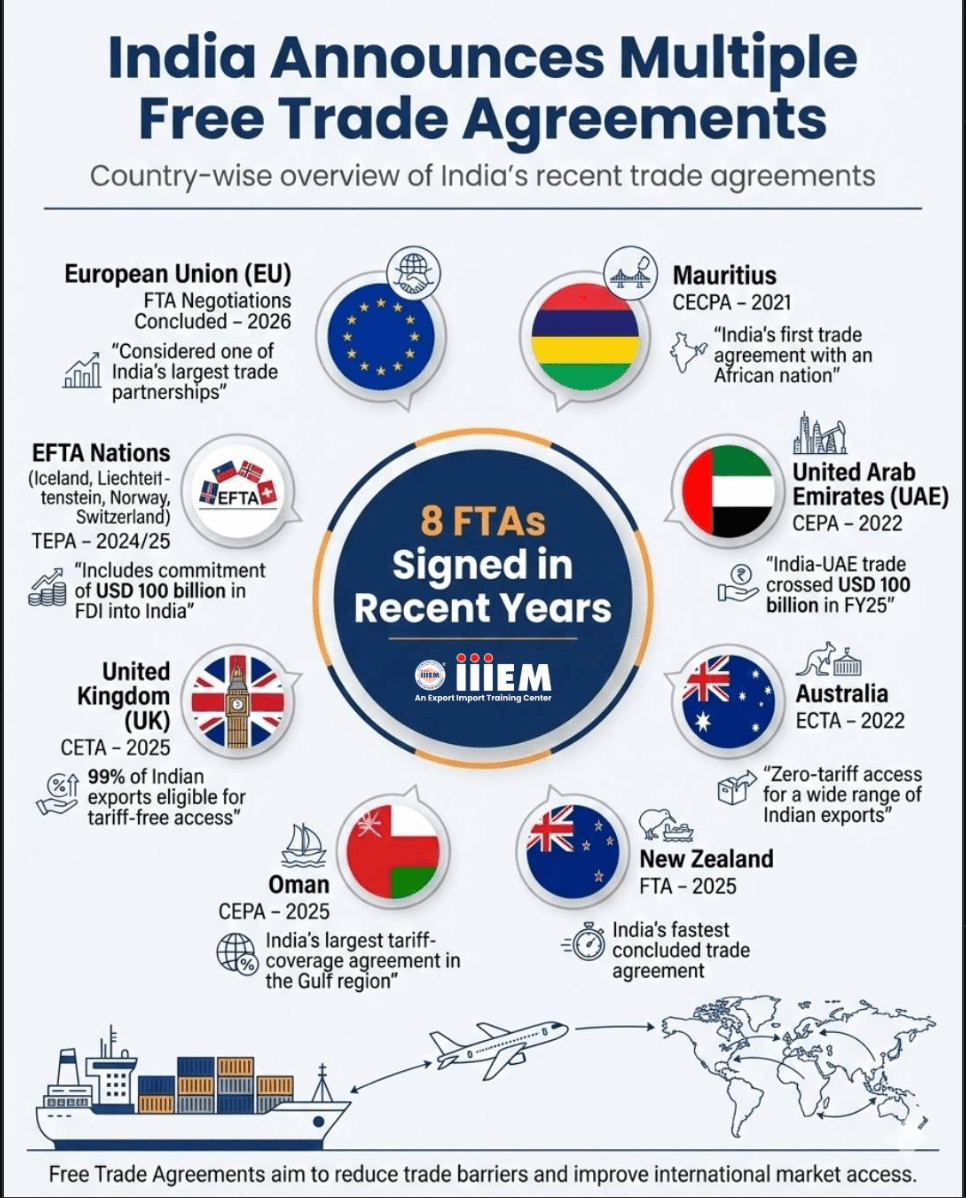
Trade agreements are unlocking new market access. The India-UK CETA signed in July 2025 goes live in May 2026, giving Indian food exporters zero-tariff access to the UK market across virtually all agricultural categories. The India-EU Free Trade Agreement signed in January 2026 reduces tariffs across 90% of goods traded between India and the EU's 450 million consumers. The India-EFTA agreement entered into force in October 2025, connecting India to Switzerland, Norway, Iceland, and Liechtenstein. And the US-India trade deal announced in February 2026 reduced tariffs on Indian goods from 50% to 18%, with Indian spices specifically exempted from the remaining reciprocal tariffs.
No other developing economy has simultaneously unlocked preferential market access to the US, UK, EU, and EFTA in the same 12-month window. For food importers in any of these markets, the landed cost arithmetic on Indian-origin products has materially improved - and will continue improving as the agreements are phased in. India's agricultural export volumes are at record highs. In FY 2024-25, India exported over $50 billion worth of agricultural and processed food products. India contributes 45% of global spice trade volume. It is the world's largest basmati rice exporter with over 22 million tonnes of annual rice exports. It is the world's largest producer and consumer of pulses, and one of the world's top lentil and chickpea suppliers. The products that food importers need - spices, rice, pulses, processed foods, teas - are categories where India's production depth is unmatched.
The geopolitical environment favours India. India is not in a trade war with the United States, the UK, or the EU. It is not party to the Middle East conflict. Its ports are fully operational. Its supply chains, which were already adapting to Cape of Good Hope routing during the 2023-2024 Red Sea crisis, are better positioned than most competing origins for the current Middle East disruption environment. In a world where geopolitical exposure is a supply chain liability, India's political stability is a genuine competitive advantage.
The Five Categories Where India Is Capturing Market Share Right Now
Spices
Indian spices such as turmeric, cumin, coriander, chili, and cardamom remain in high demand across the US, Europe, and the Middle East. Stricter quality and traceability regulations in Europe and North America are actually increasing demand for certified Indian spices - because India's Spices Board of India infrastructure, combined with FSSAI certification and export quality controls, provides the traceability documentation that demanding markets require. Organic and residue-free Indian spice exports are expected to grow significantly in 2026 as European retailers tighten pesticide MRL requirements. The RASFF alert data for 2024 showed that Indian suppliers with proper certification and steam sterilization had significantly lower rejection rates than traders without these credentials.
Basmati Rice
Basmati rice continues to dominate premium rice markets globally. With the India-UK CETA going live in May and the India-EU FTA reducing tariffs for European buyers, the economic case for Indian basmati rice imports has never been stronger. India accounts for 89% of global basmati supply. The premium positioning of Indian basmati - its Geographical Indication protection, its fragrance, its long-grain cooking characteristics - insulates it from the price competition that affects commodity rice categories.
Lentils and Pulses
The plant-based protein boom is driving consistent, accelerating demand for Indian lentils and pulses across every major market. India exported over 2.5 million metric tons of pulses in FY 2024-25. The range India can supply - red lentils, yellow lentils, chickpeas, pigeon peas, black gram, green gram - cannot be matched by any other single origin. With the global pulses market growing at a 5% CAGR and North America projecting vegan population growth to 70 million by 2027, Indian pulse exports are positioned for sustained volume growth.
Processed Foods
Ready-to-eat meals, pickles, chutneys, dehydrated vegetables, and spice powders from India are gaining strong traction globally. Dehydrated onion flakes from India are used by major European and American food manufacturers for their consistent flavour and long shelf life. Ready-to-cook Indian food formats are now stocked in mainstream retail in the UK, Australia, Canada, and the US. India's processed food export segment offers importers access to products with higher margins and stronger brand differentiation than commodity categories.
Organic Products
Buyers in Germany, the UK, and the US are actively sourcing certified organic products from India to meet sustainability goals. India's National Programme for Organic Production (NPOP) is mutually recognised by the EU, making NPOP-certified Indian exporters eligible to supply the EU organic market without a separate EU certification. The organic segment is growing at 7% annually - faster than the overall food import market - and certified supply from India remains limited relative to demand, meaning importers who build organic supply relationships now are securing a position that will be harder to replicate in three years.
The New Trade Agreements ~ A Brief Summary for Importers
It is worth having a clear picture of the agreements now active or imminent for importers across major markets.
UK buyers have the India-UK CETA entering into force in May 2026, with zero tariffs on virtually all Indian food products at entry into force. British importers need to confirm certificate of origin documentation with their Indian suppliers before the first post-CETA shipment.
EU buyers have the India-EU FTA signed January 27, 2026 - expected to enter into force by November 2026 according to Indian officials, with tariff reductions across the implementation timeline. European importers sourcing Indian spices, lentils, basmati rice, and processed foods will see progressively improving landed cost economics as the FTA phases in.
US buyers have the February 2026 US-India trade deal reducing tariffs from 50% to 18% on Indian goods, with Indian spices including pepper, cumin, and turmeric specifically exempted from remaining reciprocal tariffs. American importers who paused Indian sourcing during the tariff uncertainty period should now be running fresh landed cost calculations.
Australian buyers have the India-Australia ECTA signed in December 2022, which has been progressively reducing tariffs on Indian agricultural products. Combined with Australia's BICON-compliant Indian exporters, the framework for Indian food imports into Australia is more developed than many buyers realise.
What This Means for Your Sourcing Strategy
The convergence of multiple trade agreements, record Indian agricultural export volumes, and the broader global supply chain shift away from China and Gulf-corridor supply chains creates a specific strategic window for importers right now.
The businesses building Indian supply relationships in 2026 are doing so in the most favourable trade policy environment India has offered global buyers in decades. The tariff barriers that previously penalised Indian-origin goods in the US and UK are largely removed. The regulatory frameworks in the EU, UK, Australia, and US have all been tested by Indian exporters and are manageable for certified, professional exporters.
The practical question is not whether India is the right sourcing origin for food importers - the macro conditions answer that clearly. The practical question is whether you are building those relationships with the right suppliers: certified, traceable, compliant with the food safety requirements of your specific market, and capable of consistent quality across shipments.
At Bayharbor Exports, we supply the full range of Indian food products - basmati rice, spices, lentils, pulses, processed foods, and organic variants - with FSSAI certification, third-party laboratory testing, and full export documentation compatible with US, UK, EU, and Australian requirements. If the trade picture in this blog reflects what you are seeing in your own procurement environment, let's talk.
Our guide on the India-UK CETA and what British importers need to know covers the May 2026 implementation in detail. Our complete guide for European importers on the India-EU FTA walks through the EU agreement specifically.