The Conflict That Changed Global Food Markets Forever
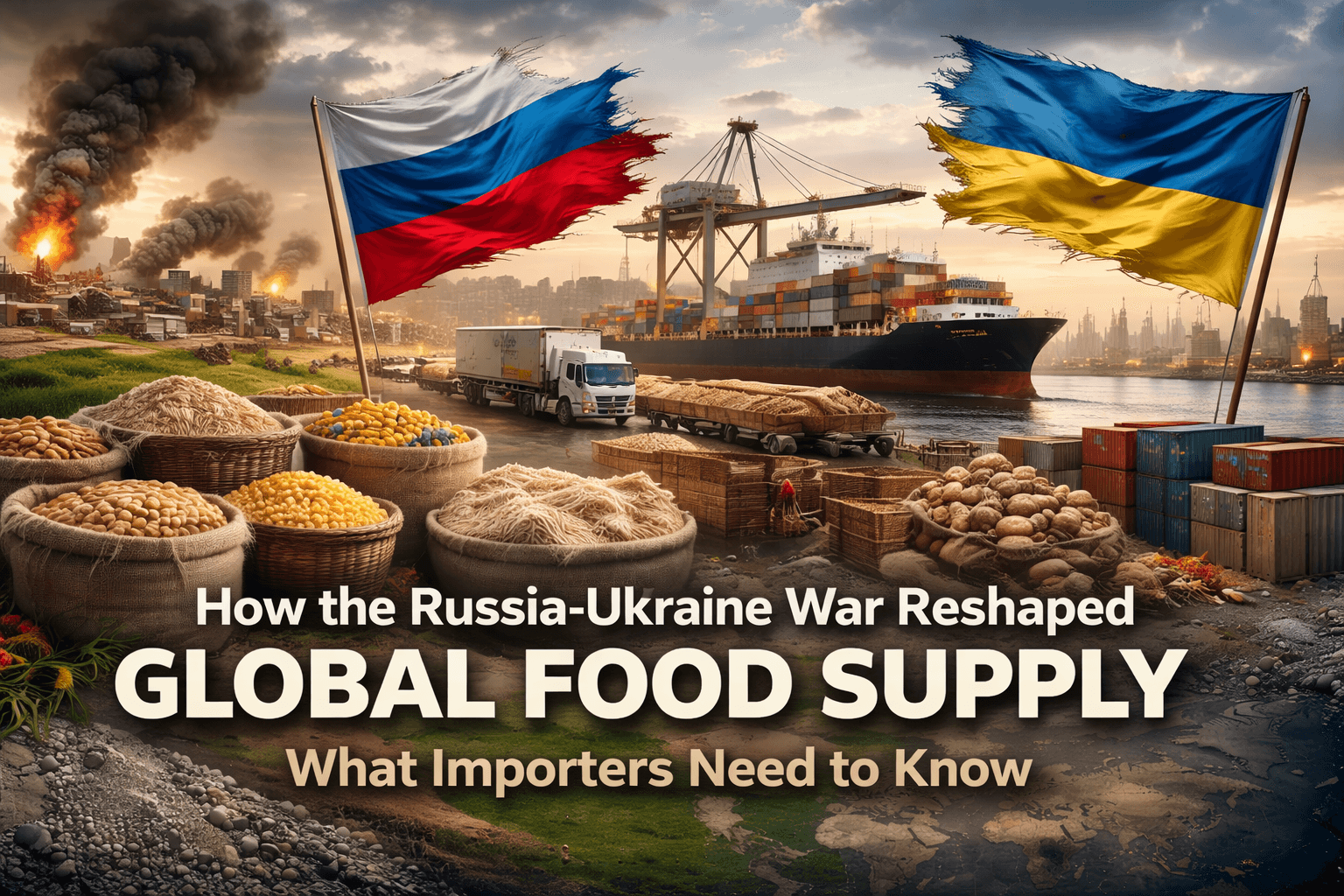
How the Russia-Ukraine War Reshaped Global Food Supply: What Importers Need to Know
The Conflict That Changed Global Food Markets Forever
When Russia invaded Ukraine in February 2022, the world lost access to what experts call "the breadbasket of Europe." Ukraine, home to approximately one quarter of the world's most fertile black soil farmland, saw its agricultural exports plummet as Russian military operations blocked Black Sea ports and destroyed farming infrastructure. The war's impact extended far beyond the battlefield, triggering a global food security crisis that continues to reshape international trade patterns, supply chains, and sourcing strategies for importers worldwide.
For food importers, wholesalers, and procurement managers across Europe, Middle East, Africa, and Asia, the conflict created immediate challenges requiring rapid adaptation. Countries that depended heavily on Ukrainian wheat, corn, and sunflower oil faced severe supply disruptions. Fertilizer shortages from Russia, one of the world's largest producers, threatened agricultural productivity globally. Food prices spiked to historic highs, forcing businesses to reconsider sourcing strategies, explore alternative suppliers, and navigate unprecedented market volatility.
Nearly four years into the conflict, the war's effects continue to reverberate through global agricultural markets. Understanding how the Russia-Ukraine war reshaped food supply chains, which regions remain most vulnerable, and what alternative sourcing opportunities have emerged is essential for importers building resilient, competitive businesses in today's transformed market landscape.
The Pre-War Food Export Dominance
Ukraine's Agricultural Powerhouse Status
Before February 2022, Ukraine ranked among the world's top agricultural exporters, accounting for 12% of global wheat exports and substantial shares of corn, barley, and vegetable oil markets. The country's extraordinarily fertile black soil, combined with favorable climate and extensive agricultural infrastructure, made it a critical supplier to food-importing nations worldwide, particularly in Middle East, North Africa, and Asia.
Ukraine's agricultural exports supported food security for hundreds of millions of people across developing economies that lacked sufficient domestic production. Countries including Egypt, Lebanon, Tunisia, and many Sub-Saharan African nations depended on consistent Ukrainian wheat shipments for bread production and basic food staples. This dependency created vulnerability that became devastatingly apparent when Russian forces invaded.
Russia's Role in Global Agriculture
Russia similarly played an outsized role in global agricultural markets, contributing 17% of world wheat exports before the invasion. Beyond grains, Russia dominated global fertilizer production and exports, supplying massive quantities of nitrogen, phosphate, and potassium-based fertilizers essential for modern agriculture worldwide. This dual position as both major food exporter and critical agricultural input supplier gave Russia significant leverage in global food systems.
The combination of Ukrainian and Russian agricultural production meant the Black Sea region supplied nearly 30% of global wheat exports, substantial corn volumes, and critical amounts of vegetable oils and fertilizers. The war's disruption of this integrated regional export system sent shockwaves through international food markets almost immediately.
Immediate War Impacts on Food Supply
Black Sea Port Blockade
Within weeks of the February 2022 invasion, Russian military forces blocked Ukraine's Black Sea ports, bringing agricultural exports to a virtual standstill. Before the war, approximately 90% of Ukraine's agricultural exports were transported by sea through ports including Odesa, Chornomorsk, and Yuzhny. The naval blockade trapped millions of tons of grain in Ukrainian silos and storage facilities, unable to reach international markets.
The export paralysis created immediate global supply shortages. Ukrainian wheat exports for 2023-2024 declined by 11% to 15 million metric tons compared to pre-war levels, while corn exports dropped 15% to 23 million metric tons. For countries dependent on these supplies, the sudden unavailability forced emergency sourcing from alternative suppliers at substantially higher prices, straining national budgets and threatening food access for vulnerable populations.
Price Spikes and Market Panic
Global food prices, already elevated due to pandemic-related market shocks throughout 2020 and 2021, hit an all-time high in March 2022 following Russia's invasion. Wheat prices surged 8-22% in the short term, with projections suggesting prices would remain 10-19% higher through 2026-2027 compared to pre-war baseline levels. The price increases reflected not just reduced Ukrainian exports but market panic about potential long-term supply constraints from the Black Sea region.
For food importers, the rapid price escalation created budgeting challenges, reduced margins, and difficult decisions about whether to pass costs to consumers or absorb them. Developing countries faced particular hardship as their currencies weakened against the dollar, making food imports even more expensive. Food price inflation exceeded 15% in over a third of low-income and lower-middle-income countries, with some experiencing 30% increases that threatened social stability.
Fertilizer Crisis Compounds Problems
Simultaneous disruption of Russian fertilizer exports compounded the global food security crisis. Western sanctions restricted Russian financial transactions and logistics, while Russia strategically limited fertilizer exports to pressure importing countries. Access to fertilizers was affected in 136 countries and territories, particularly Estonia, Mongolia, Kazakhstan, Brazil, United States, China, and India, threatening global agricultural productivity.
Fertilizer prices tripled in some markets, forcing farmers worldwide to reduce application rates or skip fertilization entirely, compromising crop yields. The cascading effect meant that even countries not directly importing from Ukraine or Russia faced reduced harvests and higher food production costs, perpetuating global food price pressure and supply tightness.
Regional Vulnerability and Dependence
Most Affected Countries
Research analyzing trade dependency revealed that 24 countries face extreme vulnerability due to nearly complete dependence on food imports from Russia and Ukraine. Georgia, Armenia, Kazakhstan, Azerbaijan, and Mongolia top the list of highly exposed nations that struggled to rapidly diversify sourcing when war disrupted supplies. These countries' food security became immediately threatened, requiring emergency international assistance and hurried development of alternative supply chains.
The Middle East and North Africa region showed particular vulnerability given historical dependence on Black Sea grain imports. Egypt, the world's largest wheat importer, sourced approximately 80% of its wheat from Russia and Ukraine before the war. Lebanon, Tunisia, Libya, and Yemen similarly relied heavily on the region, creating acute food security concerns when supplies vanished. The vulnerability extended beyond direct food imports to encompass fertilizer dependency that threatened domestic agricultural production.
Africa's Compounding Crisis
Sub-Saharan Africa faced especially severe impacts from the war's disruption of food supply chains. Already struggling with poverty, conflict, climate change impacts, and pandemic economic fallout, many African countries depended on affordable grain imports from the Black Sea region. The sudden supply loss and price spikes pushed millions toward food insecurity and potential famine conditions.
It is projected that almost 600 million people will be chronically undernourished by 2030 if war conditions persist, with Africa bearing the brunt of this humanitarian catastrophe. The Food and Agricultural Organization estimated that an additional 122 million people faced hunger in 2022 compared to 2019 due to disruptions including the Ukraine war, highlighting the conflict's devastating human toll beyond its direct combatants.
Alternative Supply Chains Emerge
Solidarity Lanes and Land Routes
Recognizing the catastrophic humanitarian implications of blocked Ukrainian grain exports, European Union and international partners worked to establish "solidarity lanes" enabling overland export routes from Ukraine through Poland, Romania, and other neighboring countries. While more expensive and logistically complex than maritime shipping, these land routes provided partial relief, allowing Ukraine to maintain reduced export volumes.
The Black Sea Grain Initiative, brokered by the United Nations and Turkey in July 2022, temporarily restored maritime exports from Ukrainian ports under international protection. From July 2022 through July 2023, Ukraine safely exported 32.9 million metric tons of grains to 45 countries, including 725,000 metric tons to the World Food Program for humanitarian relief. However, Russia's withdrawal from the initiative in July 2023 reimposed constraints on Ukrainian maritime exports, demonstrating the fragility of wartime trade arrangements.
Russia Expands Export Offensive
Paradoxically, while Ukraine's agricultural exports declined, Russia's wheat exports increased dramatically. Due to favorable growing conditions and strategic calculations, Russia's wheat exports in 2023-2024 rose by 30% compared to pre-war levels, reaching a record 51 million metric tons. President Vladimir Putin declared his intention to "replace Ukrainian grain" with Russian exports, offering low-cost or free grain to developing countries, particularly in Africa, as part of Russia's soft power strategy.
Russia completed deliveries of promised grain to African nations including Burkina Faso, Eritrea, Mali, Zimbabwe, Somalia, and Central African Republic, while trade data reveals Russia increased wheat exports to every region of Sub-Saharan Africa between 2022-2023 and 2023-2024 agricultural seasons. This export expansion positioned Russia as an indispensable supplier to food-insecure nations, creating political leverage and dependency despite ongoing international criticism of the invasion.
India's Opportunity and Challenge
India emerged as an alternative supplier for wheat and rice markets disrupted by the Ukraine war. However, India faced its own challenges including domestic food security concerns, climate-related production volatility, and infrastructure limitations. The country imposed export restrictions on wheat and rice at various points to protect domestic supplies and control inflation, highlighting how the war's impacts cascaded through global markets affecting even non-combatant countries.
For importers seeking to diversify away from Black Sea dependency, India represented an important but imperfect alternative. Indian agricultural products including basmati rice, wheat, corn, and various pulses offered sourcing options, though India's policy unpredictability and domestic priorities created their own supply chain risks requiring careful management.
Long-Term Market Transformation
Diversification Imperative
The Russia-Ukraine war fundamentally changed risk calculus for food importers worldwide. Single-source or region-concentrated sourcing strategies revealed dangerous vulnerability when geopolitical events disrupted supply. The conflict accelerated existing trends toward supply chain diversification, multi-sourcing strategies, and building redundancy despite higher costs.
Importers increasingly recognize that geographic diversification, developing relationships with suppliers in multiple countries and regions, is essential. Commodity diversification, including alternative grains and food products providing nutritional substitutes, and strategic stockpiling, maintaining larger inventory buffers despite carrying costs, have become standard risk management practices. The war demonstrated that food supply security requires investment in resilience beyond pure cost optimization.
Price Volatility as New Normal
While global food prices measured in US dollars eventually declined below pre-invasion levels by December 2022, with the FAO announcing in January 2024 that prices had fallen to their lowest level in three years, this headline recovery masks ongoing challenges. Local food prices measured in national currencies continue rising in many countries due to currency weakness, inflation, and persistent supply chain friction.
For importers, the lesson is clear: price volatility has become a structural feature of global food markets rather than temporary disruption. Successful businesses must develop sophisticated price risk management strategies including forward contracts locking in prices, financial hedging using commodity futures and options, strategic inventory management balancing carrying costs against price spike risks, and strong supplier relationships enabling preferential access and pricing during shortages.
Infrastructure and Logistics Shifts
The war accelerated investment in alternative agricultural export infrastructure. Ukraine developed expanded land export capacity through Poland, Romania, and other neighbors. The European Union invested in border crossing improvements, rail capacity expansion, and port facilities in member states neighboring Ukraine. These infrastructure developments create permanent changes in European agricultural trade flows extending beyond the immediate war period.
For global importers, these infrastructure shifts mean new logistics options and trade routes potentially offering competitive advantages. Understanding evolving transportation networks, port capabilities, and cross-border procedures in Eastern Europe and Black Sea region becomes strategically valuable even for businesses sourcing from other global regions.
Opportunities for Alternative Suppliers
South America's Expanded Role
Brazil, Argentina, and other South American agricultural exporters benefited from the conflict's disruption of Black Sea supplies. Brazilian wheat, corn, soybean, and meat exports found expanded markets in regions previously dominated by Ukrainian and Russian suppliers. The continent's counter-seasonal production relative to the Northern Hemisphere also provided year-round supply stability, valuable for importers building diversified sourcing.
South American suppliers invested in expanding production capacity, improving logistics infrastructure, and developing marketing relationships with new customers in the Middle East, Africa, and Asia. For importers, South American agricultural products offer quality, scale, and increasingly competitive pricing as production efficiencies improve and logistics mature.
North America Captures Market Share
United States and Canadian agricultural exports similarly gained from the war's market disruption. American wheat, corn, soybeans, and specialty crops filled some gaps left by reduced Ukrainian supplies. North American suppliers' advantages include established quality standards, sophisticated logistics networks, financial market depth supporting trade finance, and political stability reducing supply chain risk.
For importers prioritizing supply security and quality consistency, North American suppliers offer premium positioning despite often higher price points compared to Black Sea region alternatives. The war demonstrated that reliability and geopolitical stability carry value justifying cost premiums in certain procurement strategies.
India's Strategic Position
India's agricultural sector represents another major beneficiary of diversification away from concentrated Black Sea sourcing. Indian basmati rice, spices, pulses, and other agricultural products offer authentic quality, competitive pricing, and scale sufficient to serve major importing countries. India's strategic location between the Middle East, Africa, and Asia provides logistical advantages for many importers.
However, India's export restrictions during periods of domestic supply concern highlight the importance of multi-country sourcing even when diversifying away from conflict zones. Successful importers maintain relationships with Indian suppliers while also developing backup sources in Thailand, Vietnam, Pakistan, and other Asian agricultural exporters.
Sourcing Strategies for Resilient Supply Chains
Multi-Source Procurement
The fundamental lesson from the Russia-Ukraine war is that concentration risk in food sourcing can be catastrophic. Importers should develop multi-source procurement strategies spreading purchases across multiple suppliers in different geographic regions. While managing multiple supplier relationships increases complexity and potentially raises costs, the risk mitigation value became undeniable when Ukrainian supplies vanished overnight.
Practical multi-sourcing approaches include splitting annual volumes across two to three primary suppliers from different regions, maintaining relationships with additional backup suppliers even if not currently purchasing, and conducting regular alternative sourcing research to understand market options. The goal is building procurement flexibility enabling rapid pivoting when geopolitical or climate events disrupt specific supply sources.
Long-Term Contracts vs Spot Market
The war highlighted trade-offs between long-term supply contracts and spot market purchasing. Importers with long-term contracts suffered when contract prices exceeded rapidly rising spot market levels, while those relying on spot markets faced availability challenges and extreme price volatility. The optimal approach typically involves balanced portfolio combining contracted base volumes providing supply security with spot market purchases capturing opportunistic pricing.
Long-term contracts should include force majeure provisions addressing supply disruptions from war, sanctions, and other geopolitical events. Price adjustment mechanisms linking contract terms to market indices can help balance risk between buyers and suppliers when markets move dramatically.
Strategic Stockpiling
Maintaining larger inventory buffers, despite associated carrying costs, has become standard practice for importers prioritizing supply security after experiencing war-related shortages. Strategic stockpiling involves calculating optimal inventory levels balancing supply disruption risks, price volatility exposure, storage costs, and working capital implications.
For essential food products, particularly those with longer shelf life like grains, pulses, and spices, many importers now maintain 60-90 days inventory compared to pre-war norms of 30-45 days. This buffer provides time to develop alternative sources when primary suppliers face disruptions without immediately passing shortages to customers.
Ready to build a resilient, diversified food supply chain?
Contact Bayharbor Exports today to discuss how our Indian agricultural products can strengthen your sourcing strategy and reduce dependence on conflict-affected regions.
Bayharbor Exports - Your Stable Partner in an Uncertain World