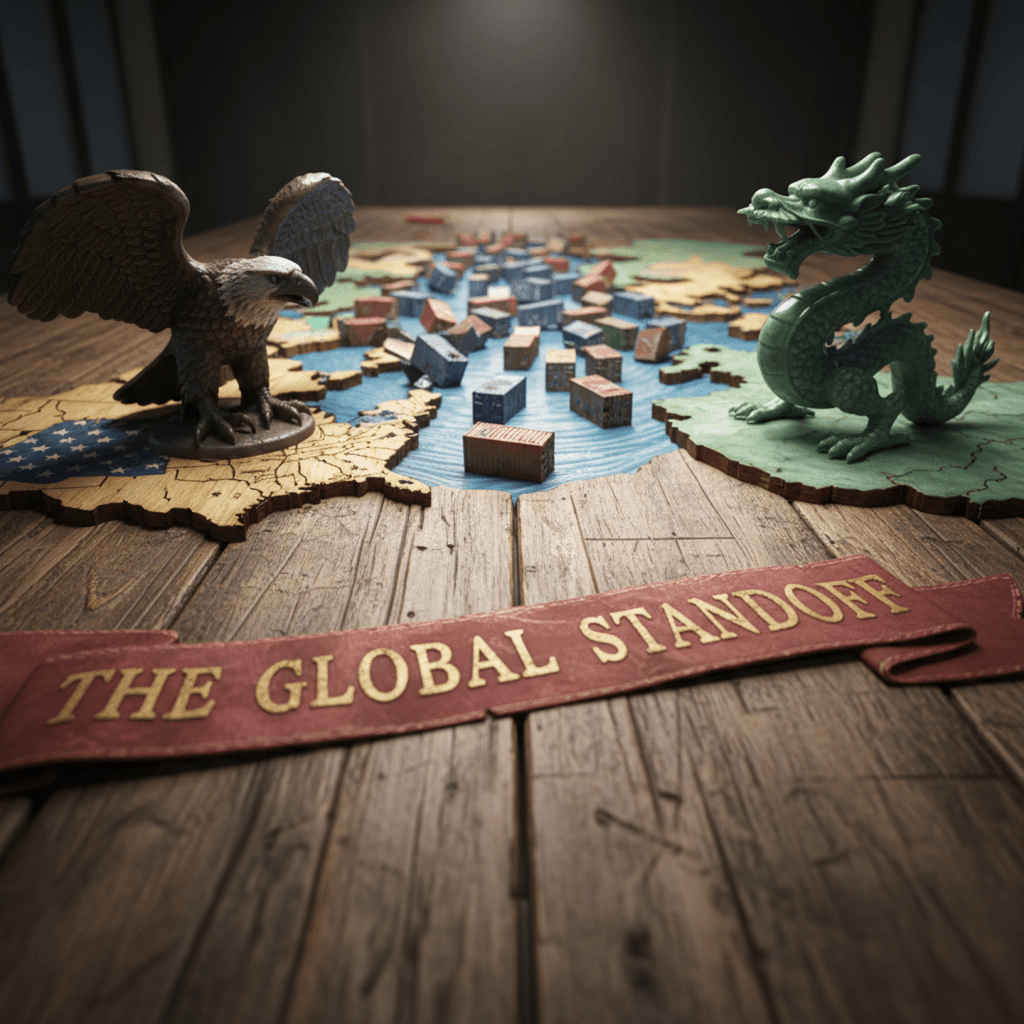
The Trade War That Changed Everything
The US-China Trade War: How Escalating Tariffs Are Reshaping Global Supply Chains
The Trade War That Changed Everything
When President Donald Trump imposed the first wave of tariffs on Chinese goods in 2018, few anticipated the conflict would escalate to unprecedented levels by 2026. Today, the United States imposes a staggering 145% tariff on Chinese goods, while China retaliates with 125% tariffs on American products. These measures are forecast to cause a 0.2% loss of global merchandise trade, but the real impact extends far beyond simple trade statistics, fundamentally restructuring how businesses worldwide source, manufacture, and distribute products.
For importers, manufacturers, and procurement professionals across every continent, the US-China trade war represents the defining challenge of this decade. Direct trade between the world's two largest economies has collapsed by approximately 90% in some scenarios, forcing a complete reimagining of supply chains that took decades to build. Companies that relied on integrated US-China manufacturing networks face existential questions about where to source components, how to manage dramatically increased costs, and whether reshoring or nearshoring strategies make economic sense.
The conflict's effects cascade through global commerce in ways both obvious and subtle. Southeast Asian countries scramble to capture manufacturing fleeing China, while struggling with infrastructure limitations and their own geopolitical considerations. European businesses navigate between American and Chinese economic spheres, seeking to maintain relationships with both while avoiding getting caught in crossfire. Developing economies watch as globalization fragments into competing blocs, threatening the integrated trade system that powered their development strategies.
The Escalation Timeline: From Trade Tensions to Full-Scale Economic War
First Wave: 2018-2019 Tariffs
The initial phase of the US-China trade war began in 2018 under President Trump's first administration, targeting what the United States characterized as unfair Chinese trade practices, intellectual property theft, and forced technology transfers. By late 2019, average US tariffs on goods from China had been raised by around 20 percentage points, covering hundreds of billions of dollars in trade. China responded with retaliatory tariffs on American agricultural products, automobiles, and other goods, marking the beginning of tit-for-tat escalation.
During this period, global businesses began what researchers later termed "The Great Reallocation," shifting sourcing away from China toward alternative manufacturing locations including Vietnam, Thailand, Mexico, and India. However, many companies adopted wait-and-see approaches, hoping diplomatic negotiations would resolve tensions and allow return to previous supply chain structures.
Biden Administration: Maintained Pressure
Despite expectations that President Joe Biden might roll back Trump-era tariffs, his administration maintained most measures in place while adding additional levies on Chinese goods including electric vehicles, solar panels, and advanced technology products. The continuity signaled that US-China trade tensions transcended partisan politics, reflecting deeper structural competition between the world's two largest economies.
During the Biden years, focus shifted somewhat from tariffs toward technology restrictions, export controls on semiconductors and related equipment, and investment screening mechanisms designed to prevent Chinese access to American technology. This broadening of economic competition tools foreshadowed the comprehensive approach that would characterize Trump's second term.
2025: Liberation Day and Unprecedented Escalation
Trump's return to the presidency in January 2025 marked a dramatic acceleration of trade tensions. On February 1, 2025, Trump signed Executive Order 14195 declaring a national emergency regarding drug trafficking from China, alleging the Chinese government provided safe haven for criminal organizations producing fentanyl. Using authority granted by national emergency and security-related acts, Trump imposed an initial 10% tariff on Chinese imports, which quickly escalated to 20% by March 4, 2025.
China responded on March 4 by imposing 15% tariffs on chicken, wheat, corn, and cotton from the United States, plus 10% tariffs on sorghum, soybeans, pork, beef, aquatic products, fruits, vegetables, and dairy products. The tit-for-tat escalation accelerated rapidly, with both sides raising stakes in what became an economic game of chicken with global consequences.
The pivotal moment came on April 2, 2025, when Trump delivered his "Liberation Day" speech announcing sweeping "reciprocal" tariffs. He raised tariffs on China by an additional 34%, claiming China maintained trade barriers of 67%. The White House confirmed these tariffs would stack on top of previous impositions, resulting in an effective tariff rate of 54% on all Chinese imports to the United States. Over subsequent months, further escalations brought US tariffs to 145% and Chinese retaliatory tariffs to 125%, representing the highest bilateral tariff levels since before World War II.
Global Trade Contraction and Economic Impact
The Numbers Tell a Stark Story
The economic devastation from the tariff war manifests clearly in trade data. US imports from China fell 28% year over year in 2025, while exports to China declined an even steeper 38%, marking one of the most significant bilateral trade contractions in recent decades. Direct trade between the United States and China may collapse by approximately 90% under full tariff implementation scenarios, fundamentally severing economic ties that bound the world's two largest economies for decades.
Global trade has been severely affected by the tariffs, with trade flows contracting by between 5.5% and 8.5% relative to pre-shock levels, depending on scenario assumptions about tariff persistence and retaliation scope. Trade flowing through global value chains—shipments that cross several borders before reaching consumers—shrinks by roughly 2 percentage points more than direct bilateral trade, indicating the tariffs' particularly severe impact on integrated manufacturing networks.
Welfare effects prove equally sobering. Welfare declines significantly in the United States by around 2% under moderate scenarios, and by nearly double that under full implementation with retaliation. The Eurozone experiences more contained but still meaningful impacts remaining below 1%, while China faces welfare losses around 1.5% across all scenarios. At the global level, welfare losses reach up to 2% under full retaliation scenarios, representing hundreds of billions of dollars in lost economic output and consumer welfare.
Sector-Specific Devastation
Certain industries face particularly severe disruption from the trade war. The decline is especially steep in sectors such as transport equipment and electrical equipment and electronics, which contract by 16% and 12% respectively in full retaliation scenarios. These sectors' deep integration in global value chains spanning multiple countries makes them extraordinarily vulnerable to tariff shocks that raise costs at each production stage.
In contrast, sectors less integrated in international supply chains, such as agriculture and rubber and plastics, experience smaller declines, though still meaningful disruptions. The differential impacts create winners and losers within economies, complicating political responses as export-oriented manufacturers lobby for tariff relief while domestic-focused industries may benefit from reduced import competition.
Tariffs increase purely domestic output in the United States—production that neither relies on foreign inputs nor serves foreign markets. However, across all scenarios this increase is not nearly enough to offset the decline in production that depends on international trade, either because it relies on imported inputs or serves foreign markets. The net effect on American manufacturing remains negative despite protectionist policies' explicit goal of boosting domestic production.
The Great Reallocation: Trade Redirects to New Patterns
Southeast Asia Emerges as Major Beneficiary
As US-China direct trade collapsed, Southeast Asian economies captured increasing shares of American-bound trade. Indonesia emerged as a leading beneficiary, posting 34% growth in US imports during 2025, while Thailand recorded a 28% increase. Vietnam, already gaining from the first trade war wave, consolidated its position as a major manufacturing alternative to China for American buyers.
However, this reallocation creates its own complications. Indirect exports of Chinese products to the United States through third countries are far less affected than direct trade, raising questions about whether tariffs genuinely reduce Chinese manufacturing or simply redirect it through intermediary nations. The re-routing of Chinese products could potentially be curbed through implementation of stricter rules of origin in the United States, such as preventing import of any product containing a specified minimum level of Chinese value added. However, these measures would likely introduce considerable inefficiencies, leading to substantially higher transaction costs and potential disruptions to well-established supply chains.
Chinese value-added imported by the United States before the trade war shock and under full retaliation scenarios shows dramatic shifts by exporting country, with Vietnam, Mexico, and other nations serving as transit points for Chinese components and sub-assemblies ultimately destined for American markets. This pattern suggests tariffs may be less effective at reducing Chinese manufacturing than proponents hoped, instead creating additional logistics complexity and cost without fundamentally altering production locations.
Mexico and Nearshoring Strategies
Mexico has similarly benefited from companies' desires to reduce China exposure while maintaining proximity to American markets. The United States-Mexico-Canada Agreement (USMCA), despite brief tariff hiccups in early 2025, provides a relatively stable framework for North American manufacturing integration. Mexican imports to the United States have grown substantially, particularly in automotive, electronics, and consumer goods sectors.
However, Mexico faces its own challenges including security concerns affecting business operations, infrastructure bottlenecks limiting rapid capacity expansion, and labor market tightness in key manufacturing regions. Not every product and industry can easily relocate from Asia to Mexico, particularly those requiring extensive supplier ecosystems or specialized technical capabilities concentrated in Asian manufacturing clusters.
India's Strategic Opportunity
India represents another major beneficiary of diversification away from concentrated Chinese sourcing. Indian exports across multiple sectors including textiles, electronics, automotive components, and pharmaceuticals have found expanded markets as American and European buyers seek China alternatives. India's strategic location between the Middle East, Africa, and Asia provides logistical advantages for serving multiple global markets.
The Indian government has actively promoted manufacturing through initiatives like Production-Linked Incentive schemes targeting strategic sectors, attempting to capitalize on the "China plus one" or "China alternative" sourcing trend. However, India faces its own constraints including a complex regulatory environment, infrastructure gaps, and relatively higher manufacturing costs compared to China and some Southeast Asian competitors.
Corporate Strategies and Survival Tactics
The Apple Model: Lobbying and Exemptions
Apple serves as a case study in how corporate influence intersects with geopolitics amid trade war pressures. Despite rising tariffs, the United States granted exemptions for phones and computers moves that came shortly after Apple reportedly chartered private cargo planes to fly iPhones out of Southeast Asia before tariff deadlines hit. Apple's response demonstrates how largest corporations with political connections may secure favorable treatment unavailable to smaller businesses.
The company has gradually diversified production into India and Vietnam while maintaining a substantial Chinese manufacturing presence, attempting to balance supply chain resilience with China's unmatched scale and capabilities. Apple's strategy involves maintaining maximum flexibility to shift production volumes between countries as tariff and geopolitical situations evolve, though this approach requires substantial capital investment and ongoing management complexity.
Mid-Sized Manufacturer Struggles
Companies lacking political clout face much harsher realities. Mid-sized manufacturers are hit hardest by price increases, sourcing delays, and limited access to tariff exemptions, all exacerbated by the current US-China trade war climate. These businesses must navigate tariff complexity without the resources to maintain political relationships or rapidly diversify supply chains across multiple countries.
Many mid-sized companies face difficult choices including absorbing tariff costs and accepting reduced margins, passing costs to customers and risking lost sales, or undertaking expensive and time-consuming supply chain restructuring with uncertain outcomes. For businesses operating on thin margins in competitive industries, these choices may threaten viability.
Diversification as Corporate Imperative
Across company sizes and industries, the trade war has made supply chain diversification mandatory rather than optional. Businesses adopt several common strategies including shifting production to more politically stable regions like Mexico, India, or Eastern Europe, investing in domestic infrastructure and building relationships with US-based or nearshore suppliers, and planning for strategic risk by building models accounting for future tariffs, shipping disruptions, and geopolitical instability.
The diversification imperative conflicts with decades of supply chain optimization focused on cost minimization and just-in-time inventory management. Companies must now balance efficiency against resilience, accepting higher costs and complexity to reduce concentration risk and build flexibility enabling rapid pivoting when geopolitical shocks occur.
Long-Term Structural Changes Fragmentation of Global Trade System
The US-China trade war accelerates fragmentation of the integrated global trading system that characterized the hyperglobalization era from 1990s through 2010s. Rather than convergence toward unified rules and seamless cross-border commerce, the world increasingly divides into competing economic blocs centered on the United States and China, each with associated partners and supply chains.
This fragmentation creates significant inefficiencies as companies maintain parallel supply chains serving different markets, duplicate investments in manufacturing capacity, and navigate incompatible regulatory frameworks. The costs of this duplicated infrastructure ultimately flow to consumers through higher prices while reducing global economic growth by making trade more expensive and complex.
Technology Decoupling
Beyond manufactured goods, the trade war drives technological decoupling between American and Chinese innovation ecosystems. US export controls on semiconductors, artificial intelligence technologies, and other advanced capabilities aim to prevent Chinese access to cutting-edge American technology. China simultaneously invests massively in achieving technological self-sufficiency, as evidenced by announcements like the 14th Five-Year Plan emphasizing technological self-reliance and innovation as national priorities.
The technology decoupling creates separate spheres in critical sectors including semiconductors and chip manufacturing equipment, artificial intelligence and machine learning systems, telecommunications equipment and standards, and biotechnology and pharmaceutical innovations. Businesses operating globally must navigate between these systems, potentially developing separate products and capabilities for different markets.
Reshoring and Industrial Policy
The trade war has revitalized industrial policy in both the United States and globally, with governments actively seeking to reshore strategic industries rather than relying on market forces to determine production locations. The United States pushes forward with initiatives like the CHIPS and Science Act to boost domestic semiconductor production, offering substantial subsidies to attract manufacturing investment.
However, reshoring proves difficult due to lost technical knowledge after decades of offshoring, outdated domestic infrastructure in many manufacturing sectors, and lack of sufficient government subsidies to overcome cost disadvantages versus Asian production. While some strategic industries may successfully reshore, complete reversal of globalization remains impractical for most sectors.
Regional Winners and Losers
Developing Asia: Cautious Optimism
Vietnam, Thailand, Indonesia, India, and other Asian developing economies benefit substantially from manufacturing relocation out of China. These countries attract foreign investment, create manufacturing jobs, and integrate more deeply into global value chains. However, they face challenges including infrastructure limitations constraining rapid scaling, labor market pressures as demand surges, and geopolitical risks of getting caught between US-China competition.
Production outside the United States as measured by PMI manufacturing output had been generally increasing in the first quarter of 2025 before dropping below 50 into contraction territory in April in China, South Korea, and Vietnam. May's releases showed Vietnam already starting to recover, demonstrating these economies' vulnerability to trade policy shocks despite benefiting from overall reallocation trends.
Europe: Caught in the Middle
European businesses and policymakers face difficult choices navigating between American and Chinese economic spheres. Europe maintains significant trade relationships with both countries and depends on Chinese manufacturing for many products while also benefiting from transatlantic economic ties and security relationships with the United States.
European Union members share American concerns about Chinese trade practices including subsidies, intellectual property protection, and market access. However, Europe also fears getting drawn into US-China conflict and damaged by secondary effects of tariffs on global trade. The challenge involves maintaining economic relationships with both powers while protecting European interests and avoiding forced alignment with either side.
Africa and Latin America: Commodity Exporters Squeezed
Resource-rich developing economies depending on commodity exports face challenging dynamics from the trade war. Reduced global economic growth from trade tensions dampens demand for commodities including metals, energy products, and agricultural goods. Additionally, many developing economies have accumulated substantial debts denominated in dollars or other hard currencies, making them vulnerable to currency fluctuations and capital outflows during periods of global uncertainty.
Some resource exporters benefit from certain patterns, such as increased Chinese demand for commodities as Beijing seeks to reduce dependence on American-controlled supply chains. However, overall, the trade war's negative effects on global growth and uncertainty around trade rules create difficult conditions for commodity-dependent economies.
What Importers and Businesses Should Do Immediate Action Steps
Businesses affected by US-China trade tensions should take several immediate actions including conducting comprehensive supply chain audits identifying China-dependent components and products, evaluating alternative sourcing options across multiple countries and regions, modeling financial impacts of various tariff scenarios on costs and margins, and engaging with suppliers to understand their own contingency plans and flexibility.
For companies not yet significantly affected, complacency proves dangerous. The trade war's scope continues expanding, and sectors currently exempt from major tariffs may face future targeting as the conflict evolves. Building supply chain flexibility and understanding alternative sourcing options positions businesses to respond quickly when circumstances change.
Medium-Term Strategic Planning
Beyond immediate fire-fighting, businesses need medium-term strategic planning addressing the fundamentally changed trade environment. This includes diversifying supply chains by spreading purchases across multiple suppliers in different geographic regions, investing in nearshoring or reshoring for strategic products where cost premiums are acceptable, building inventory buffers to provide time for supply chain pivoting without immediately passing shortages to customers, and developing scenario planning capabilities modeling various geopolitical and tariff futures.
Companies should also consider regionalization strategies, developing separate supply chains optimized for serving North American, European, and Asian markets rather than attempting to serve global markets from single manufacturing locations. While less efficient than fully integrated global supply chains, regional strategies reduce exposure to cross-border trade disruptions.
Building Resilience for Long-Term Uncertainty
The fundamental lesson from the US-China trade war is that geopolitical risk must be central to supply chain strategy rather than an afterthought. Building resilient supply chains involves accepting higher costs and complexity to reduce concentration risk, investing in supplier relationship development across multiple countries, maintaining flexibility to rapidly shift sourcing when disruptions occur, and using technology for supply chain visibility and rapid decision-making.
Long-term stability will likely come from a combination of strategic supply chain risk management, increased domestic and nearshore manufacturing capacity where economically viable, and globally diversified supplier bases reducing dependence on any single country or region. Businesses that invest in these capabilities now will be better positioned to navigate ongoing uncertainty over the next decade.
Why Partner with Bayharbor Exports
Stable Alternative Amid Trade War Chaos
Bayharbor Exports provides reliable sourcing from India, offering a stable alternative to China-dependent supply chains caught in US-China tariff crossfire. India's non-aligned geopolitical position and strong relationships with both the United States and China provide businesses with supplier options avoiding the worst trade war impacts.
Our product range spanning agricultural products, textiles, light manufacturing, and specialized products enables diversification across multiple categories. Whether you're seeking complete China replacement or supplementary sourcing reducing concentration risk, Bayharbor Exports provides quality products, competitive pricing, and reliability essential for building resilient supply chains.
Understanding of Global Trade Dynamics
We recognize the complexities businesses face navigating the transformed trade environment. Our team stays current on evolving tariff situations, trade regulations, and geopolitical developments affecting global supply chains. We provide not just products but strategic partnership helping you understand implications of trade policy changes and plan accordingly.
For businesses developing multi-country sourcing strategies, we offer expertise connecting Indian manufacturing capabilities with your specific requirements. Our experience serving customers across Americas, Europe, Middle East, and Asia means we understand diverse market needs and regulatory frameworks.
Competitive Positioning Under Trade War Conditions
India's improving infrastructure, expanding manufacturing capabilities, and competitive labor costs position Indian suppliers favorably as businesses diversify away from China. Recent trade agreements including the India-US and India-EU frameworks enhance India's attractiveness as a sourcing destination.
Bayharbor Exports leverages these advantages to deliver competitive pricing on quality products meeting international standards. Our efficient operations, direct supplier relationships, and logistics expertise ensure you capture benefits of Indian manufacturing while minimizing transition complexity and risk.
Ready to build a resilient supply chain for the new era of global trade?
Contact Bayharbor Exports today to discuss how Indian sourcing can reduce your exposure to US-China trade war disruptions while maintaining quality and competitive pricing.
Bayharbor Exports - Your Strategic Partner in a Fragmenting World